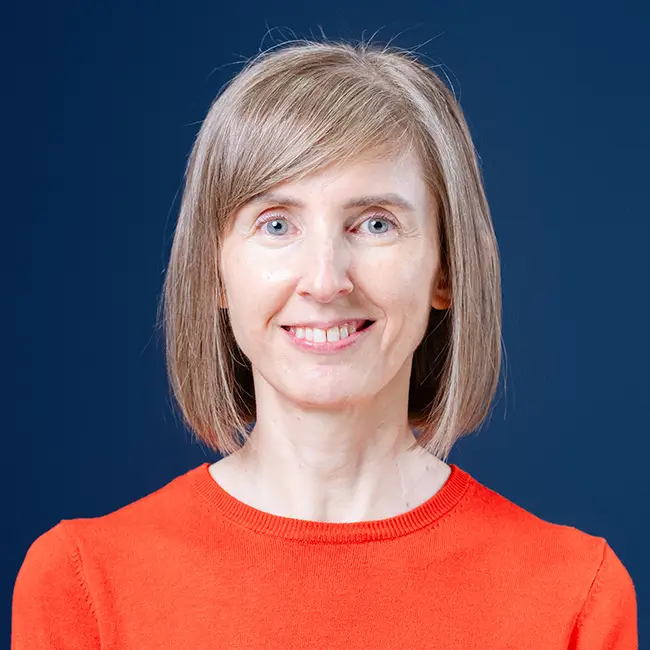
Professor Claire Vermaak

Professor Claire Vermaak

Professor Claire Vermaak

Associate Professor

Discipline Economics
Contact

031 260 2577

Campus Westville
Office Address J Block room 304

Academic Qualifications

  • PhD (UKZN)
  • MCom (UKZN)
  • BCom(Hons) (Natal)
  • BSc (Natal)

Biography

Professor Claire Vermaak is a senior lecturer in economics. She holds a Bachelor of Science, a Bachelor of Commerce Honours, a Master of Commerce and a PhD from the University of KwaZulu-Natal. She specialises in teaching data analysis skills (econometrics) and research methods, as well as labour economics, to post-graduate students. Professor Vermaak’s research focuses on the analysis of survey data to improve the well-being of individuals and households. This research makes both academic and public policy contributions, focusing on issues including the labour market (access to employment, the extent of low-wage work and the role of immigration), gender inequalities (in labour market outcomes, health and time use), and service delivery (the impacts of household electricity access and energy poverty).  

Research Interests

  • Labour economics
  • Employment, unemployment and wages
  • Immigration
  • Household electricity access and usage
  • Energy poverty
  • Time use

Professional Qualifications

Selected Publications

  • Vermaak, C. and Muller, C. (2019). “Do immigrants have better labour market outcomes than South Africans?” Development Southern Africa, forthcoming. DOI: https://www.tandfonline.com/doi/full/10.1080/0376835X.2019.1584549
  • Rathi, S.S. and Vermaak, C. (2018). “Rural electrification, gender and the labor market: A cross-country study of India and South Africa.” World Development 109, pp. 346-359.
  • Harris, G. and Vermaak, C. (2015). “Economic inequality as a source of interpersonal violence: evidence from sub-Saharan Africa and South Africa.” South African Journal of Economic and Management Sciences 18(1), pp. 1-13.
  • Posel, D., Casale, D., & Vermaak, C. (2014). “Job Search and the Measurement of Unemployment in South Africa.” South African Journal of Economics 82(1), pp. 66-80.
  • Kimemia, D., Vermaak, C., Pachauri, S. and Rhodes, B. (2014). “Burns, scalds and poisonings from household energy use in South Africa: Are the energy poor at greater risk?” Energy for Sustainable Development 18, pp. 1-8.
  • Vermaak, C. (2012). “Tracking poverty with coarse data: evidence from South Africa.” Journal of Economic Inequality 10(2), pp. 239-265.
  • Vermaak, C., Kohler, M. and Rhodes, B. (2009). “Developing Energy-based Poverty Indicators for South Africa.” Journal of Interdisciplinary Economics 21(2), pp. 163-195.

Recent topics supervised:

  • NEET status and mental health in South Africa: a longitudinal analysis
  • Time use among young NEET (Not in Education, Employment or Training) South Africans
  • A double disadvantage? A gender-sensitive analysis of African immigrants’ labour market outcomes in South Africa
  • Returns to education for the wage employed and self-employed in South Africa
  • Provincial variation in the effect of minimum wage laws in South Africa, 2000-2007
  • Social diversity and economic outcomes: the measurement of social fractionalisation in South Africa
  • Education and the gender wage gap in South Africa
  • The effects of marital status on labour market participation, employment and wages in Lesotho
  • The impact of the Child Support Grant on child health and education outcomes