The College of Law and Management Studies (CLMS) congratulates Dr Nomfundo Kakaza from the Graduate School of Business and Leadership (GSB&L); Dr Jenasha Tooray and Dr Mudaray Marimuthu from the School of Management, Information Technology and Governance; and Dr Alastair Marais from the School of Accounting, Economics and Finance, who graduated with their PhDs at the recent UKZN Autumn Graduation ceremony.
“Value Chain Analysis of the Informal Economy Banana Market in the Onderberg District, Mpumalanga”, was the title of Kakaza’s study supervised by Professor Micheline Naude. It explored exclusionary practices within the banana value chain in South Africa’s informal economy and suggests an inclusive model that significantly contributes to the academic field. While focused on the Onderberg District in Mpumalanga, its implications extend across Africa – particularly in addressing supply chain challenges exacerbated by the COVID-19 pandemic – and offer valuable insights to improve value chains for informal street vendors, thereby promoting broader economic inclusion.
‘In a context of persistent unemployment, where individuals in the informal economy innovate tirelessly to sustain livelihoods with minimal governmental support, championing their contributions within academia becomes vital,’ said Kakaza.
She added that the study’s findings are valuable as they map the country’s first comprehensive banana value chain that explicitly recognises the role and contributions of the informal economy, and propose an innovative, inclusive model that directly addresses systemic challenges faced by the informal sector.
‘My work amplifies the visibility and economic value the informal sector brings to fruit and vegetable value chains, a sector often overlooked in policy and research. Equally critical is advancing actionable frameworks to strengthen the resilience of informal economies, ensuring they are not merely recognised but actively supported as engines of equitable growth and community stability.’
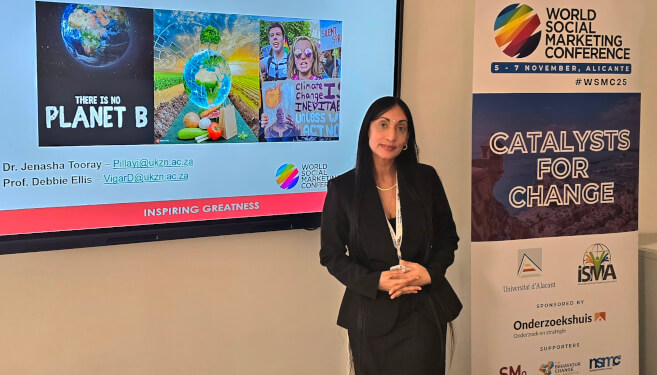
Through her research titled: “Young Consumers’ Purchase Intentions Towards Plant-Based Products During the Global Climate Crisis and Coronavirus Pandemic”, Tooray hopes to raise awareness about climate change and the benefits of a plant-based diet for both human and planetary health, particularly among the youth. The study was supervised by Professor Debbie Ellis.
‘As a passionate vegan, climate change activist and advocate for plant-based living, I have dedicated my life to promoting a lifestyle that prioritises animal welfare, environmental sustainability and human health. It is my love for animals and our planet that drives my commitment to this cause, and I am also passionate about researching and advancing knowledge within my field,’ said Tooray.
The study revealed that many young consumers are beginning to incorporate plant-based products weekly, with others doing so monthly. The findings also propose mechanisms for green marketing practitioners and governments to encourage the purchase of plant-based products, raise awareness about climate change, and demonstrate how such diets can reduce carbon emissions and significantly benefit both human and planetary health.
‘This is a start in a predominantly meat-eating country, such as South Africa. Since global warming is accelerating at unprecedented levels, humanity should be encouraged, through targeted policy intervention, to reduce meat consumption to avoid further environmental degradation and even address health issues,’ said Tooray.
“Tone at the Top’s Role in the Detection and Prevention of Financial Statement Manipulation in South Africa” was the title of Marais’s study supervised by Professor Claire Vermaak and Dr Patricia Shewell.
‘My research focused on how tone at the top moderates the effectiveness of various governance mechanisms in preventing financial statement manipulation. “Top at the top” refers to the ethical culture that top management creates in an organisation. Financial statement manipulation refers to fraud and other mechanisms used to deceive the user of financial statements and paint a picture of the company that differs from reality,’ said Marais.
Using data from non-financial firms on the Johannesburg Stock Exchange (JSE), the study revealed that the CEO’s tone was found to indirectly influence manipulation by moderating the effectiveness of key monitoring mechanisms. Consequently, regulators and investors must understand the role of tone at the top to ensure that monitoring mechanisms are effective rather than ceremonial.
‘There is a great importance of my research, especially when we look at the large corporate frauds (such as Steinhoff, Tongaat Hulett and EOH, to name a few) which have taken place in South Africa. These frauds don’t just happen overnight and my research puts a spotlight on the role of tone at the top in enabling and potentially facilitating financial statement manipulation, which can have devastating effects on our country’s economy,’ said Marais.
“A Model for DevOps Implementation in South Africa” was the title of Marimuthu’s research supervised by Dr Sanjay Ranjeeth and Professor Indira Govender. The thesis investigated the evolution of DevOps, a software development process that enables software to be deployed rapidly so that companies can achieve early operational efficiencies and, consequently, competitive advantage.
Words: Thandiwe Jumo
Photographs: Sethu Dlamini